


Staying in the U.S. and All You’ve Worked For Are at Risk All Because of Your Spouse. |
 |
You manage major responsibilities at work or in your business, yet face a spouse who uses your immigration status to control you. You’re trying to hold it together.
-
Will USCIS believe you?
-
Is this enough for a VAWA case?
-
Can you keep your spouse from finding out?
Know If You Can Pursue a Green Card on Your Own Terms.
Men Experience Abuse, Too. But Often Don’t Call It Abuse. |
 |
You may handle difficult decisions at work every day, yet find yourself giving in to your spouse’s demands just to keep the peace at home.
Perhaps you’ve:
-
stopped seeing certain friends,
-
handed over money to avoid another argument, or
-
learned to watch what you say.
You may keep it private because you’re embarrassed, your culture doesn’t support you leaving your spouse, you still love your spouse, or worry that no one will take you seriously.
Sound familiar? You’re not the only one.
GUIDANCE AT EVERY STAGE
You’re Not Alone in this Mess – We’ve Been There Before. |
We rarely see a truly simple case. Complicated histories, sensitive facts, and cases that do not fit neatly into one category are familiar territory for us.We listen without judgment, explain what matters, and stay involved so you know where you stand and what comes next.
|
|

|
Osman
IS IT ABUSE OR “EXTREME CRUELTY”?
When Your Spouse Uses Your Immigration Status Against You |
Your spouse may never hit you. But threats, financial demands, and controlling behavior can leave you making decisions out of fear of what your spouse might do next.
Your Money Comes with Demands.Your spouse demands money, runs up debt in your name, or drains your savings while threatening consequences if you refuse. |
Your Green Card Becomes a Bargaining ChipYour spouse threatens to withdraw sponsorship, call immigration authorities, or refuse to attend your interview unless you do what they want. |
Your Career & Reputation Become TargetsYour spouse interferes with your work, embarrasses you in front of colleagues, or threatens to lie to the police to pressure you into complying. |
Your Relationships SufferYour spouse monitors your calls, restricts contact with friends or family, or makes maintaining those relationships increasingly difficult. |
You may have options that don’t depend on your spouse’s cooperation. But not every controlling or hurtful act qualifies as extreme cruelty under immigration law.
USCIS POLICY CHANGES
VAWA Cases by Men Face New Challenges Under Tougher USCIS Scrutiny. |
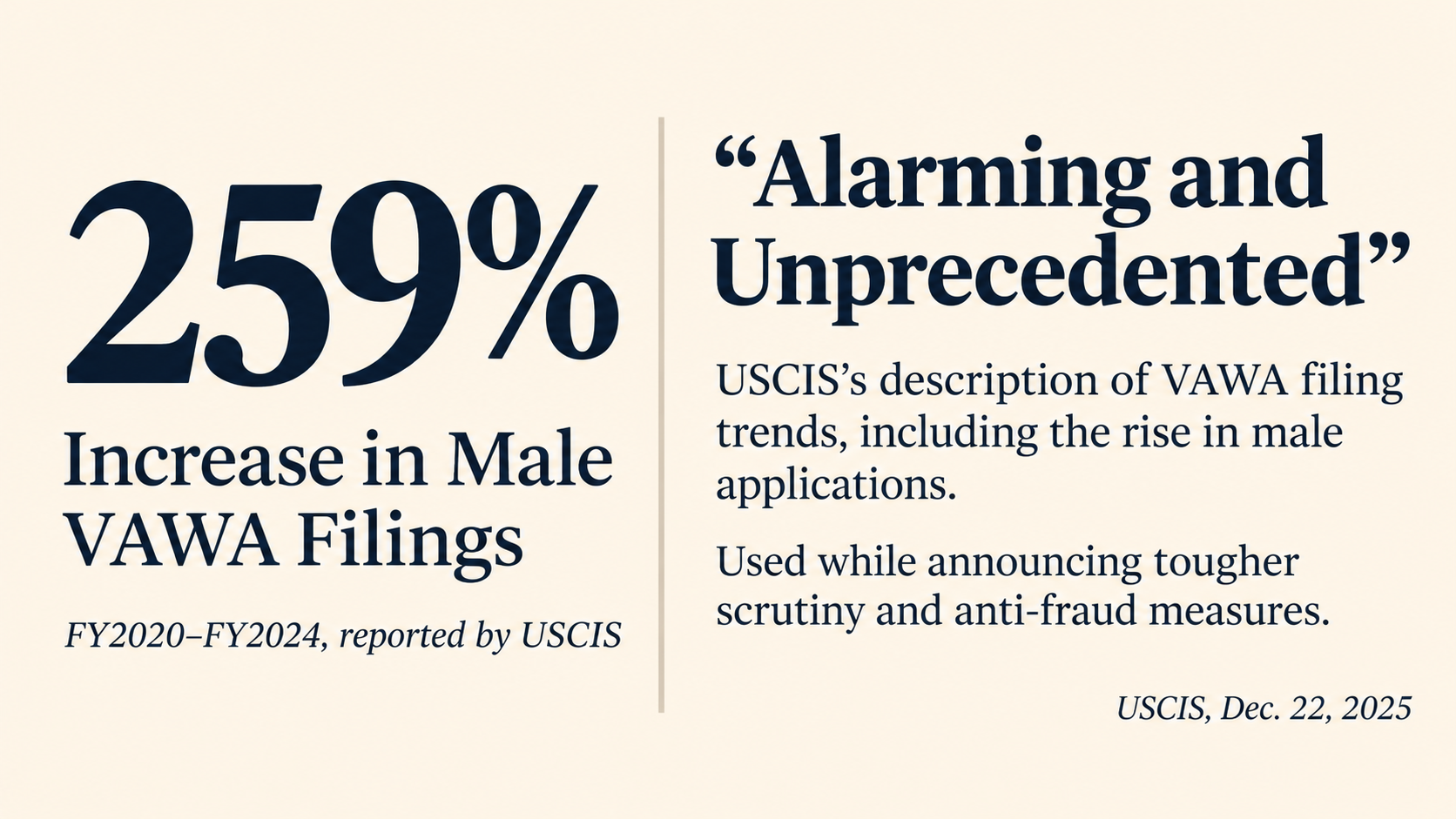
In December 2025, USCIS tightened its guidance for VAWA cases and singled out a 259% increase in applications by men as part of its concerns about fraud. USCIS now places greater emphasis on:
-
Extreme Cruelty: Was the psychological abuse severe enough to qualify, even without physical violence?
-
Good-Faith Marriage: Did you enter the marriage for genuine reasons, even if you kept separate finances or your spouse later turned against you?
-
Credibility & Evidence: Can you prove what happened, especially if you kept the abuse private or never reported it?
-
Shared Residence: Did you live with your spouse during the qualifying relationship, even if you later separated?
These changes can pose particular challenges for men who experienced psychological abuse without physical violence, never reported the mistreatment, or kept their marital problems private.
The challenge is showing USCIS why your particular circumstances meet the legal standard—not simply describing an unhappy marriage.
Financial extortion, immigration threats, and psychological control can be difficult to prove as extreme cruelty—especially when a man has a successful career, substantial assets, and no history of physical abuse.
We understand how these circumstances can strengthen a VAWA claim, even when USCIS may initially see ordinary marital conflict. She develops evidence and legal arguments that address the seriousness of the abuse, the credibility of the client’s account, and questions about the marriage itself.
YOUR PLAN
When your immigration situation feels complicated, you need to know what matters, what to do next, and what to expect. Here’s how we work together:
Attorney
Heather.
Tell Attorney Heather what’s at stake. Explore the options that may be available.
Get Your
Custom Plan.
Know the path we recommend, where your case is strong or vulnerable, what could hurt it, and what facts or options you may not have considered that could improve your chances of approval.
Plan Happen
Together.
Put the strategy into action—with guidance along the way.
- Written instructions tailored to your case – not a generic checklist
- Detailed feedback on your evidence & what’s missing
- Coordinate with the witnesses and professionals who can help support your case
- Know what the government may question – and how to prepare.
FREQUENTLY ASKED QUESTIONS
Get Answers – VAWA for Men |
When your immigration status affects your career, travel, and independence, you need straight answers. Heather identifies what may be possible, where your case could face challenges, and which direction makes sense—so you can make informed decisions without wasting time.
Does My Experience Qualify as Abuse?
Can I qualify for VAWA if my spouse never physically hurt me or threatened violence?
Yes. VAWA recognizes psychological abuse as a form of violence. You do not need to show that your spouse hit you or threatened physical harm. However, USCIS examines the seriousness of the conduct and whether it reflects an intention to gain or maintain power and control over you.
Under 8 CFR § 204.2(c)(1)(vi), qualifying abuse includes any act or threatened act of violence resulting in, or threatening, physical or mental injury. Under VAWA, psychological abuse can qualify as an act of violence, even without physical violence or threats of physical harm. The challenge is distinguishing extreme cruelty from ordinary marital conflict or hurtful behavior. USCIS may have difficulty recognizing that distinction without understanding the full circumstances.
Heather has represented men whose cases involved psychological abuse, financial pressure, and immigration threats. She evaluates what happened, whether it may meet USCIS’s standard, and how to present the facts and supporting evidence persuasively.
Can financial demands, humiliation, controlling behavior, or isolation qualify as extreme cruelty?
Yes, depending on the circumstances. Financial pressure, humiliation, controlling behavior, and isolation can contribute to extreme cruelty under VAWA, even without physical violence.
A spouse who repeatedly demands money, interferes with your relationships, humiliates you, or uses your immigration status to control your decisions may be engaging in more than ordinary marital conflict.
Under USCIS’s December 2025 guidance, the distinction matters. USCIS examines the seriousness of the conduct, its purpose, and whether your spouse intended to gain or maintain power and control over you.
Not every financial demand or insulting remark meets the standard for extreme cruelty. But financial pressure and humiliation may become part of a broader pattern of control when your spouse threatens to withdraw immigration sponsorship, damage your professional reputation, or jeopardize your livelihood. These threats can also isolate you from friends, family, or colleagues who might otherwise support you.
Heather regularly works with cases involving only financial and psychological abuse and sometimes, the threat of physical violence. She examines how your spouse’s conduct affected your life, identifies the facts that matter under immigration law, and develops the evidence and arguments needed to explain why your circumstances may meet the standard for extreme cruelty.
What if my spouse demanded expensive gifts, a car, or large payments in exchange for cooperating with my green card application?
Financial demands tied to your immigration status may support a VAWA claim for extreme cruelty. If your spouse threatens to withdraw immigration sponsorship, refuse to attend your green card interview, or take your children unless you provide money, expensive gifts, a car, or financial support for their relatives, those demands may be part of a pattern of coercion and control.
Even threats to withhold sex or affection, give you the silent treatment, or cut off communication may matter when your spouse uses them to pressure you into meeting financial demands. Whether these actions contribute to extreme cruelty depends on the full circumstances.
Financial records can tell very different stories. Large bank or Zelle transfers, expensive jewelry or other personal purchases on joint or authorized-user credit cards, a car titled in one spouse’s name, property deed transfers, or a lump-sum divorce settlement payment may provide evidence of financial extortion. But those same transactions can raise questions about whether you entered the marriage in good faith and USCIS may question whether this is evidence of bribing your spouse to help you get a green card.
USCIS has questioned these types of financial arrangements in cases Heather has handled, including through Requests for Evidence and immigration interviews.
A transaction isn’t inherently evidence of abuse or marriage fraud. Its significance depends on the circumstances and how the attorney uses and explains it. Heather carefully reviews financial and property records before filing. She identifies which transactions strengthen a claim of abuse, which may raise questions about the marriage, and which require additional explanation or proof. Her judgment about what evidence to present, when to present it, and how to address potential concerns can make a critical difference in how USCIS understands your case.
Can my spouse’s interference with my career, business, or professional reputation qualify as extreme cruelty?
Yes. When your spouse uses threats, harassment, or interference with your work to control you, that conduct may contribute to extreme cruelty under VAWA, even without physical violence.
Heather has handled cases where spouses repeatedly called their husbands at work, contacted supervisors and coworkers, and even showed up at their workplaces yelling and making scenes. Some confronted their husbands in front of colleagues, forced them outside for public arguments, or threatened to return and cause further embarrassment unless their husbands met their demands. In some cases, the disruption caused clients to lose their jobs.
These actions can threaten your income, career advancement, professional relationships, business opportunities, and reputation. They can also isolate you from colleagues who might otherwise support you.
Not every workplace argument or embarrassing incident qualifies as extreme cruelty. Heather examines the pattern and purpose of your spouse’s conduct, its effect on your professional life, and how it connects to other controlling behavior. She identifies the evidence that matters and develops persuasive arguments to show USCIS why the conduct may constitute extreme cruelty rather than ordinary marital conflict.
Can I qualify for VAWA if I’m financially successful, professionally established, or earn more than my spouse?
Yes. Financial success does not prevent you from experiencing extreme cruelty. Even if you earn a substantial income, own a business, or support your household, your spouse may use your immigration status, career, children, or reputation to control you.
The fact that you can afford your spouse’s financial demands does not mean you willingly accept them. Your spouse may demand increasingly expensive gifts, money for friends or relatives, or payment of personal expenses while threatening consequences if you refuse. You may feel trapped, used for money, and worried that the demands will never end.
Heather has represented men who continued paying their spouses’ expenses under threats involving their immigration cases. In one case, a husband continued paying credit card bills that included hotel and restaurant charges from his wife’s affair. Although he knew she was cheating, he felt trapped because she threatened to withdraw her immigration sponsorship or stop cooperating with his green card case if he refused her demands.
Without understanding those threats, USCIS could question why he continued paying and whether the payments were intended to secure immigration sponsorship rather than support a genuine marriage.
Heather examines the financial records, the spouse’s demands and threats, and the history of the relationship. She identifies which facts may establish extreme cruelty, anticipates questions about the marriage, and exercises judgment about how to present the evidence so USCIS can understand the circumstances behind the payments.
What if my spouse threatens to make false police accusations, contact my employer, or damage my reputation?
Yes. If your spouse threatens to make false police accusations, files false reports, or uses restraining-order proceedings to intimidate or control you, that conduct may support a VAWA claim for extreme cruelty.
Heather has represented men whose spouses made false accusations of violence, filed false police reports, or threatened to harm themselves and tell the police their husbands were responsible. Some spouses also sought restraining orders containing false allegations, forcing clients to take time away from demanding jobs to defend themselves in court. These situations can threaten your career, professional reputation, and independence, even when you have never physically harmed your spouse.
A police report or restraining-order filing can also complicate your immigration case. USCIS may examine the allegations, regardless of whether a court ultimately dismisses the case. A dismissal does not automatically prove that the accusations were false.
In both male and female VAWA cases, Heather has used restraining-order filings containing false allegations, together with court records showing their dismissal, as evidence of the abusive spouse’s attempts to exert control. She carefully evaluates the allegations, the reasons for dismissal, and the surrounding circumstances to determine how to address potentially damaging records and present a credible account to USCIS.
What if my spouse monitors my movements, withholds my immigration documents, or threatens me when I try to leave?
These actions may support a VAWA claim for extreme cruelty, even without physical violence. Monitoring your whereabouts, controlling your communications, withholding important documents, or threatening you when you try to leave can form part of a pattern of coercion and control.
Our male clients have had spouses use GPS tracking to monitor their movements, demanded access to their phones and passwords, and reviewed their calls and text messages. Some spouses sent messages from the clients’ phones to interrogate their friends. Other abusive spouses stayed in the room during phone or video calls to monitor conversations or forbade their spouses from speaking their native language so they could understand everything being said.
In multiple cases, their spouses also took their passports, identity documents, or proof of legal status. Almost universally, the abusive spouse threatened to withdraw immigration sponsorship when their husbands resisted their demands.
We get that these actions can leave you with little privacy or independence. They may restrict your ability to travel, manage your immigration affairs, or speak freely with friends and family who could support you.
But not every disagreement about privacy or personal boundaries qualifies as extreme cruelty. Heather examines how these actions fit together, their purpose, and their effect on your independence and relationships. She identifies the evidence that matters, develops arguments to explain the pattern of control to USCIS, and evaluates your immigration options without relying on your spouse’s cooperation.
What if my spouse hit me only once?
A single incident of physical violence may be enough to qualify for VAWA. The law does not require repeated physical abuse or a pattern of violence in every case.
Under its December 2025 guidance, USCIS emphasizes the seriousness of the conduct and the full circumstances surrounding it. An isolated incident may not establish extreme cruelty in every case, but USCIS cannot reject a claim simply because the violence happened only once.
Heather examines what happened, the circumstances surrounding the incident, and the available evidence to assess whether the conduct meets VAWA’s legal standard. She also considers whether other forms of psychological abuse, intimidation, or control strengthen the case.
Remember, VAWA does not require physical violence at all. Psychological abuse may also qualify as extreme cruelty.
Can I qualify for VAWA if I’m a man married to another man?
Yes. VAWA protects men in same-sex marriages. If your spouse is a U.S. citizen or lawful permanent resident and subjected you to battery or extreme cruelty during your marriage, you may qualify to pursue a VAWA green card without your spouse’s cooperation.
Abuse in a same-sex marriage can take forms that go beyond physical violence. Your spouse may threaten to reveal your sexual orientation to family, friends, coworkers, employers, or members of your religious community. If those people do not accept your sexual orientation, disclosure could threaten your relationships, career, reputation, or even your safety. The fear of losing that support can leave you increasingly isolated and give your spouse greater power and control.
Other conduct may include threats to disclose private medical information, sexual humiliation or coercion, interference with LGBTQ community relationships, or threats to withdraw immigration sponsorship. Not every hurtful act meets USCIS’s standard for extreme cruelty, but the full circumstances matter.
Heather has successfully represented men whose U.S. citizen husbands withheld immigration sponsorship or interfered with their green card applications to keep them dependent and discourage them from leaving the relationship. Heather developed evidence of the abuse, and her clients obtained green cards without their husbands’ cooperation or knowledge. They gained the independence to decide whether to leave their marriages or remain without having to accept abuse to protect their immigration status.
Heather’s representation of one LGBTQ VAWA survivor appeared in a 2024 Super Lawyers feature article, All The World Is Waiting for You.
Heather evaluates the abuse, your marriage history, and any immigration complications to determine whether VAWA offers a realistic path forward while protecting your privacy and independence.
Will USCIS Believe Me and My Marriage?
What if I never called the police, sought medical treatment, or told anyone about the abuse?
You may still qualify for VAWA. USCIS does not require police reports, restraining orders, medical treatment, or photographs of physical injuries to establish battery or extreme cruelty.
Many men keep abuse private. You may have feared retaliation, worried about your professional reputation, wanted to protect your children, or felt uncomfortable discussing what happened. If your spouse used financial coercion, immigration threats, or psychological abuse rather than physical violence, you may never have had a reason to seek medical treatment.
Most of Heather’s VAWA cases do not involve traditional evidence of abuse. She has successfully developed cases using financial records showing repeated overdrafts or unusual spending, text messages, emails, phone logs, recordings, GPS tracking records, photographs of damaged property, and other evidence that supports the client’s account.
Even when you believe nobody knew about the abuse, someone may have witnessed or overheard an incident without knowing the full story.
Heather carefully examines your history, identifies evidence that may not initially seem important, and exercises judgment about what will credibly establish the abuse. She anticipates questions about missing records, develops supporting evidence and legal arguments, and presents the circumstances in a way USCIS can understand.
Could a prenuptial agreement, separate finances, or limited joint assets make USCIS question whether my marriage was genuine?
Yes. USCIS may question a marriage when spouses have separate bank accounts, few joint assets, or a prenuptial agreement. But these arrangements do not automatically mean you entered the marriage for immigration purposes or prevent you from qualifying for VAWA.
Couples keep their finances separate for many reasons. They may be young and have few assets, want to protect a business or investments, or have a spouse who struggles to maintain employment, has substance abuse problems, repeatedly spends beyond their means, or cannot responsibly use a shared credit card.
Heather has obtained VAWA approvals for clients with separate finances and very limited joint assets. She examines why the couple kept their finances separate, who paid the household expenses, and what other evidence demonstrates that the marriage was genuine.
Prenuptial agreements can present additional challenges, especially when they contain unusually one-sided provisions. Heather reviews the terms of these agreements, assesses their significance to the immigration case, and determines whether and how to present them with appropriate context and supporting evidence.
Heather’s experience allows her to anticipate how USCIS may interpret unusual financial arrangements, identify evidence beyond joint accounts and property ownership, and develop persuasive arguments establishing that you entered your marriage in good faith.
What if large Zelle transfers, expensive purchases, or payments to my spouse’s family look suspicious?
Financial records that look suspicious to USCIS do not necessarily mean your marriage was fraudulent. Large Zelle or bank transfers, expensive gifts, credit card charges, or payments to your spouse’s relatives may reflect ordinary family arrangements—or financial pressure and abuse.
Heather has handled VAWA cases where USCIS questioned substantial transfers between spouses, expensive purchases, and charges on joint or authorized-user credit cards. Officers have raised concerns about financial arrangements in Requests for Evidence and immigration interviews, including payments connected to divorce settlements.
These records can tell very different stories. You may have willingly supported your spouse or their family while your marriage was going well. Or your spouse may have demanded increasing amounts of money, made purchases without your agreement, or threatened to withdraw immigration sponsorship unless you kept paying.
The challenge is that USCIS may interpret the transactions as payments for immigration cooperation rather than evidence of a genuine marriage or financial coercion. The same records may support your account of abuse, raise questions about your marriage, or both.
Heather carefully reviews the financial history before filing. She examines why the payments occurred, how they relate to your relationship and any abuse, and what other records can explain them. She then exercises judgment about which evidence to present, what requires additional context, and how to address USCIS’s concerns while establishing that you entered your marriage in good faith.
What if my marriage was short, we lived apart for work, or I moved out to escape the abuse?
You may still qualify for VAWA. A short marriage, time spent living apart for work, or moving out because of abuse does not automatically prevent you from qualifying.
Under USCIS’s December 2025 guidance, you must establish that you entered the marriage in good faith and shared a residence with your spouse during the marriage. USCIS does not require a minimum period of living together, and you do not need to continue living with your spouse when you file.
Your career may have required frequent travel, temporary assignments, or a separate residence. Or you may have moved out because of your spouse’s abuse. These circumstances can explain unusual living arrangements, but you must still establish that you actually lived together during the marriage.
Heather has obtained VAWA approvals for men whose marriages involved brief periods of living together or separate residences due to work. She examines the history of the relationship, the reasons for the living arrangements, and what the available records reveal about the couple’s shared life.
She also anticipates how USCIS may interpret separate addresses, limited joint records, or a short marriage. Heather identifies which facts and evidence matter and develops persuasive explanations to establish a genuine marriage and the required shared residence, even when the circumstances do not resemble a conventional household.
Does it hurt my VAWA case if my spouse files for divorce or annulment instead of me?
Not usually. Who files for divorce generally matters less than whether you can prove that you entered your marriage in good faith, experienced battery or extreme cruelty, and meet VAWA’s other requirements.
Some abusive spouses file for divorce to retaliate, pressure you into returning home, or demand money or other concessions. They may even threaten to continue the proceedings unless you meet their demands.
What can hurt your VAWA case is ignoring the court papers or failing to challenge important inaccuracies. Your spouse may provide false dates about when you lived together or separated, misrepresent your shared property, or accuse you of marrying solely for immigration benefits. If you do not respond, those allegations may become part of a court record that USCIS later examines.
Annulments can create even greater problems. Unlike an ordinary divorce, an annulment requires specific legal grounds, such as fraud. Your spouse must establish those grounds under state law, and you may have grounds to contest the case and seek a divorce instead. But if you ignore the proceedings, a court may enter an annulment by default. Challenging that judgment later can be difficult, especially if you knew about the case and chose not to participate.
Some immigrants do not even know their spouses filed for annulment after they moved out of the marital home. If you suspect your spouse has started proceedings, checking the appropriate court’s records and consulting a family-law attorney promptly can be important.
Heather has handled VAWA cases involving contested divorces, annulments, and appeals. In one case, her client successfully contested an annulment, and the court converted the matter to a divorce. The abusive spouse then appealed the dismissal of the annulment claim.
Heather coordinates with family-law counsel to address these overlapping risks. She evaluates how allegations, judgments, or settlements could affect your immigration case while considering your spouse’s history of threats and retaliation. Her goal is to protect your VAWA eligibility without overlooking the personal and professional consequences of the family-court dispute.
If your marriage has already legally ended, a separate VAWA filing deadline may apply. Generally, you must file within two years and establish a connection between the abuse and the marriage’s termination.
Could agreeing to a quick divorce settlement or ignoring divorce papers hurt my VAWA case?
Yes. A quick divorce settlement or unanswered court papers can create problems for your VAWA case, even when you simply want to end the marriage and move on.
You may be willing to give up property, pay your spouse a lump sum, or agree to unfavorable terms to avoid further conflict. Your spouse may also threaten to report you to immigration authorities, contact the police, or interfere with your career if you challenge their demands.
But the terms of a settlement can raise questions. Large payments to your spouse may appear to be payments for immigration cooperation rather than part of a genuine marriage or the result of financial coercion. Statements about when you lived together, when you separated, or why the marriage ended may also conflict with your immigration records.
Ignoring divorce or annulment papers can create additional risks. Your spouse may make inaccurate claims about your relationship, finances, or intentions when you married. If you fail to respond, the court may issue a default judgment, leaving allegations in the record that USCIS could later examine.
Heather has represented VAWA clients facing disputed financial arrangements, false allegations, and complicated divorce or annulment proceedings. She reviews proposed settlements and court records for immigration consequences and coordinates with family-law counsel to identify what needs attention before you sign or respond.
Her advice takes more than the legal documents into account. She also considers your spouse’s history of retaliation, your professional responsibilities, and what you want to achieve from the divorce, so you can make informed decisions without unnecessarily putting your immigration case at risk.
What if my spouse claims our marriage was fraudulent or makes false allegations in divorce or annulment proceedings?
Your spouse’s accusations do not automatically mean your marriage was fraudulent or that USCIS will deny your VAWA case. But false allegations can create serious problems when your spouse makes them in court, withdraws immigration sponsorship, or gives damaging information to USCIS.
Your spouse may claim you married only for a green card, never lived together, or paid money in exchange for immigration cooperation. USCIS may compare those allegations with your prior immigration filings, interview statements, financial records, and divorce or annulment proceedings.
There is an important legal difference between failing to prove a good-faith marriage and USCIS establishing marriage fraud. The government must meet a higher evidentiary standard to establish marriage fraud under INA § 204(c). An abusive spouse’s accusations alone do not establish that finding. USCIS does not have to make a formal fraud finding under INA § 204(c) before it can deny a VAWA petition for failure to establish a good-faith marriage.
Heather has challenged USCIS marriage-fraud allegations in VAWA cases, including Notices of Intent to Deny (NOIDs) based on alleged inconsistencies or supposedly insufficient marriage evidence. Her experience includes a VAWA denial that the government reversed on appeal after questioning the couple’s financial records and photographs.
Heather examines the entire immigration and family-court record, identifies what USCIS may have misunderstood, and determines which facts, evidence, and legal arguments can address the concerns. She also coordinates with family-law counsel when divorce or annulment allegations threaten your immigration case.
The goal is not simply to dispute your spouse’s accusations. It is to establish the truth of your marriage and give USCIS persuasive reasons to recognize it.
Are VAWA cases for men harder to win under USCIS’s newer policies?
Male VAWA applicants may face greater scrutiny under USCIS’s newer policies, although the law protects men and women equally.
In its December 2025 announcement, USCIS singled out a 259% increase in male VAWA petitions, described recent filing trends as alarming, and connected those trends to concerns about fraud. The agency also stated:
“We are prioritizing the integrity of the immigration process and the VAWA program as a resource for women and other alien survivors of abuse.” (Emphasis added.)
Although USCIS has not announced a higher legal standard for men or established that the increase in male VAWA filings contributed to an increase in fraudulent cases, its public statements are troubling. By emphasizing VAWA as a resource for women while highlighting rising male applications alongside fraud concerns, the agency’s language strongly suggests skepticism toward male applicants and raises serious concerns about potential bias in how officers evaluate their cases.
Under its updated guidance, USCIS places greater emphasis on credibility, good-faith marriage evidence, shared residence during the marriage, and whether the conduct meets the standard for battery or extreme cruelty.
Heather has represented male VAWA clients for more than two decades, including men who experienced financial extortion, psychological abuse, immigration threats, and career interference without traditional evidence of physical violence.
She closely examines the relationship and immigration history, anticipates questions about credibility and financial arrangements, and develops the evidence and legal arguments needed to explain the abuse. She also gives you a candid assessment of your case’s strengths, weaknesses, and risks before recommending how to proceed.
How Can I Protect My Immigration Status, Career & Independence?
What happens if my spouse withdraws my I-130 petition? Can I keep my pending green card application or work permit?
Yes, you may be able to preserve your pending green card application and related work authorization if you act before USCIS denies your adjustment application.
If your spouse withdraws the I-130 petition supporting your pending green card application (Form I-485), USCIS may deny the I-485 because it no longer has a qualifying petition to support it. That can also jeopardize your work permit and advance parole based on the pending adjustment application. A spouse cannot undo a withdrawal (take back the I-130 cancellation) simply by telling USCIS they changed their mind. That is why acting before USCIS receives the withdrawal and denies the related adjustment application can be critical.
You may be able to file a VAWA self-petition (Form I-360) and request that USCIS substitute it for the I-130 as the basis for your existing I-485. Preserving that application may also preserve your eligibility for adjustment-based work authorization and advance parole.
If your spouse refuses to attend your green card interview, you generally still need to attend if you want to ask USCIS to hold your pending I-485 while you file a VAWA self-petition. USCIS has a procedure that may allow you up to 30 days to file the I-360. You can also make an appropriate request before the interview.
If you believe attending the interview could put you at risk because your spouse might appear, consult an immigration attorney beforehand. Your attorney can evaluate how to address the safety concern while seeking to preserve your pending adjustment application.
If USCIS has already denied your I-485 because your spouse withdrew the I-130, you generally must file a new adjustment of status application based on your VAWA case, if eligible. You cannot simply file an I-360 afterward and substitute it into the denied I-485. You may also need to apply for new work authorization and advance parole based on the new adjustment application. That can mean additional filing costs, delays, and potential interruptions to your ability to work or travel.
Heather evaluates the status of your I-130, I-485, work permit, and advance parole before recommending how to proceed. She identifies whether you may preserve your existing filings or need a new VAWA-based application, with particular attention to avoiding unnecessary interruptions to your employment and ability to travel.
Can I pursue VAWA without my spouse, employer, or professional colleagues finding out?
Yes. You can file a VAWA self-petition without telling your spouse or obtaining their consent. Federal law provides special confidentiality protections for VAWA applicants.
Federal law generally prohibits USCIS employees from disclosing your VAWA filing or other protected case information to your abusive spouse. USCIS also uses special identity-verification procedures to prevent a spouse from obtaining that information by calling or visiting the agency. Limited legal exceptions permit certain disclosures, such as to authorized law enforcement officials for legitimate purposes, but they do not give your abusive spouse a right to access your case.
But legal confidentiality does not eliminate every practical risk. Your spouse may monitor your phone, email, mail, bank accounts, or movements. If you share devices or accounts, even communications with your attorney could reveal that you’re pursuing an immigration case without your spouse’s knowledge.
Your employer generally does not need to know that you filed for VAWA. However, if your work authorization changes, you may need to provide updated employment documents. That does not necessarily require you to disclose the abuse or your VAWA petition to your employer or colleagues.
Heather has successfully represented men who obtained green cards through VAWA without their abusive spouses’ knowledge or cooperation.
From the beginning, Heather’s firm takes practical steps to protect your privacy. You can establish a separate email address, agree on safe ways for us to contact you, and use our law firm’s address as your mailing address on your immigration applications. That way, USCIS sends your immigration notices to our office instead of your home, reducing the risk that your spouse will discover what you’ve filed.
Heather evaluates your immigration situation, confidentiality concerns, and practical risks to develop a plan that limits unnecessary disclosure while you pursue an independent immigration future.
Can I keep working, change employers, accept a promotion, or run my business while my VAWA case is pending?
Yes, you may be able to do all of these things, depending on your current work authorization and immigration filings. Filing a VAWA petition (Form I-360) alone does not authorize you to work. However, if you have a pending green card application (Form I-485), you may qualify for a work permit that allows you to work for different employers or operate your own business.
For many of Heather’s clients, maintaining a valid work permit is essential. They may need to change employers, accept new opportunities, support their families, or continue operating businesses that require frequent travel, commercial vehicle rentals, and identification. Work authorization can also affect their ability to obtain a Social Security number or driver’s license, depending on their circumstances and state requirements.
If your work permit depends on a pending I-485 that your spouse sponsored, the timing of your VAWA case can become critical. If your spouse withdraws the underlying I-130, USCIS may deny your adjustment application, jeopardizing your work authorization and advance parole.
Heather has handled cases where preserving the existing I-485 meant filing a VAWA self-petition and asking USCIS to substitute it for the I-130 before the spouse withdrew sponsorship. Depending on the circumstances, she may also evaluate filing a separate VAWA-based I-485 and new work-permit application as a backup if the original adjustment case faces denial.
Neither approach guarantees uninterrupted work authorization. USCIS must determine whether you qualify for the requested filings. Whether the agency holds a pending I-485 or allows a change to its underlying petition also depends on the circumstances and USCIS’s decision.
Heather examines your current work authorization, pending applications, career obligations, and the risk that your spouse may withdraw sponsorship. She weighs the timing and risks of preserving your existing I-485 against filing a new VAWA-based application, explains why she recommends a particular approach, and works to avoid unnecessary interruptions to your career, business, and financial independence.
Can I travel internationally for business or to visit family while my VAWA case is pending?
You may be able to travel internationally while your VAWA case is pending, but even approved advance parole does not guarantee that you can return to the United States. A trip abroad could jeopardize your immigration case, career, and ability to return to your family.
A major change in immigration law makes travel particularly risky if you previously accumulated unlawful presence in the United States. In August 2026, the Board of Immigration Appeals overturned Matter of Arrabally and Yerrabelly, a decision immigrants had relied on for years. Under the new ruling, Matter of Delcarmen-Lara, departure with advance parole can trigger the three- or ten-year unlawful-presence bars, depending on your immigration history. Certain VAWA exceptions or waivers may apply, but you cannot assume that advance parole protects you.
Even without an unlawful-presence problem, CBP has discretion to decide whether to parole you into the United States when you return. Having an approved advance-parole document does not guarantee reentry.
Travel also creates risks while USCIS reviews your case. You could receive a Request for Evidence or Notice of Intent to Deny (NOID) while abroad. A NOID generally gives you no more than 30 days to respond, which can make gathering evidence and preparing a persuasive response particularly difficult when you’re overseas. USCIS may also deny certain applications without first issuing either notice.
Your spouse could create additional complications by withdrawing the I-130 supporting your pending green card application while you’re outside the country. That could jeopardize the I-485 and the advance parole connected to it.
Heather regularly advises VAWA clients to postpone international business trips or family visits when the immigration risks outweigh the benefits of traveling. She reviews your history of unlawful presence, pending applications, travel authorization, and the possibility that your spouse may interfere with your case. She then explains the risks and recommends whether traveling makes sense or waiting offers a safer path toward protecting your ability to live and work in the United States.
How long could my VAWA case take, and when might I qualify for a work permit or green card?
VAWA cases can take several years, but you may qualify for a work permit and advance parole travel permission while you are waiting. The timing depends on your immigration history, your relationship to the abusive family member, and whether you qualify to apply for your green card while your VAWA petition remains pending.
You can check USCIS’s current estimated processing times for VAWA petitions and other immigration applications using its online processing-times tool. These estimates change and do not guarantee when USCIS will decide your individual case.
If your abusive spouse is a U.S. citizen, Heather typically files your VAWA petition (Form I-360 filing with supporting evidence), green card application (Form I-485), and work-permit application (Form I-765) filings together, when you qualify. Because spouses of U.S. citizens fall within the immediate-relative category, they do not face a family-based visa waiting list.
Similar concurrent-filing options may be available to qualifying parents who experienced abuse by a U.S. citizen son or daughter age 21 or older, and to qualifying children who experienced abuse by a U.S. citizen parent. Certain children may also qualify for VAWA protection after turning 21, up to age 25, under special circumstances.
Filing these applications together does not mean USCIS will issue your work permit or advance parole immediately. But an eligible pending I-485 can provide a basis to apply for employment authorization and advance parole before USCIS decides the I-360. A VAWA filing or prima facie determination alone does not authorize employment or international travel.
If your abusive spouse is a lawful permanent resident, visa availability may affect when you can file the I-485 and request a work permit based on that application. Some applicants can file concurrently; others must wait.
Your green card follows a separate timeline. USCIS must approve your VAWA petition and determine that you qualify for adjustment of status.
For many of Heather’s clients, the immediate concern is maintaining their ability to work, change employers, operate a business, or obtain identification while waiting for a decision.
Heather evaluates your eligibility to file applications together, the status of any existing I-485 or work permit, and the risks of delays or interrupted employment authorization. She explains which filings make sense, when to pursue them, and what you can realistically expect while USCIS processes your case.
Can I still pursue VAWA if I’m separated or divorced from my abusive spouse?
Yes. You may qualify for VAWA even if you no longer live with your abusive spouse or your divorce is already final. You do not have to remain in an abusive marriage to pursue a green card.
If you’re separated but still legally married, you can file a VAWA self-petition without your spouse’s cooperation. USCIS does not require you to continue living together when you file. However, you must establish that you shared a home during the marriage, entered the marriage in good faith, and meet VAWA’s other requirements.
If you’re already divorced, you generally must file your VAWA petition within two years after your divorce becomes final. You must also show a connection between your spouse’s battery or extreme cruelty and the end of your marriage. Your divorce does not have to cite abuse as the reason for ending the marriage.
If you filed your VAWA petition before the divorce, the divorce itself generally does not end your pending case. However, remarriage before USCIS approves your I-360 can affect your eligibility.
Timing and divorce records matter. Your spouse may make false claims about when you separated, whether you lived together, or why the marriage ended. Those statements can create questions about your VAWA eligibility, especially when divorce or annulment proceedings involve allegations of marriage fraud.
Heather has represented VAWA clients facing separations, contested divorces, annulments, and disputes over the history of their marriages. She evaluates filing deadlines, court records, and the circumstances surrounding the separation or divorce. She also coordinates with family-law counsel when necessary to address issues that could affect your immigration case.
Heather’s goal is to identify a realistic path to permanent residence that no longer depends on your abusive spouse’s cooperation, so you can make decisions about your relationship and future with greater independence.
Can I qualify for a VAWA green card if I entered the U.S. illegally, overstayed my visa, or have other immigration problems?
Yes. You may still qualify for a VAWA green card even if you entered the United States illegally, overstayed your visa, or worked without authorization. VAWA provides special immigration protections that can allow eligible applicants to obtain permanent residence despite problems that might prevent them from qualifying through an ordinary marriage-based green card case.
An illegal entry does not automatically require you to leave the United States for a green card interview. Unlike most family-based applicants, qualifying VAWA self-petitioners may apply for adjustment of status in the United States even if they entered without inspection. Overstaying a visa or working without authorization also does not automatically prevent VAWA adjustment.
However, VAWA does not forgive every immigration violation. Prior deportations, multiple illegal entries, immigration fraud, false claims to U.S. citizenship, or certain criminal histories may create separate barriers. Some applicants qualify for exceptions or waivers; others face restrictions that VAWA alone cannot overcome.
These distinctions matter because leaving the United States could trigger additional immigration penalties, including the three- or ten-year unlawful-presence bars. Recent changes in the law have also increased the risks of using advance parole to travel after accumulating unlawful presence.
Heather examines your complete immigration history, including past entries, departures, applications, and encounters with immigration authorities. She identifies which violations VAWA may overcome, which require a separate waiver or legal argument, and whether you have a realistic path to a green card without leaving the United States.
Her goal is to identify the risks before you make a decision that could interrupt your career, separate you from your family, or jeopardize your ability to remain in the country.
Can my children qualify for immigration benefits through my VAWA case?
Yes. Your children may qualify for green cards through your VAWA case, even if they did not experience abuse themselves. This can include children from a previous relationship who are not biologically related to your abusive spouse.
Some abusive spouses use a child’s uncertain immigration status to control the father. Heather has represented men whose spouses delayed filing green card applications for their children or threatened to have their children deported. Abusive spouses may also humiliate, insult, or mistreat fathers in front of their children, frightening the children and humiliating the father. These actions can pressure a father to remain in the marriage or comply with demands to protect his children.
If you file a VAWA petition as an abused spouse, you can generally include your unmarried children under 21 as derivative beneficiaries. Your children do not have to prove that your spouse abused them to qualify through your petition.
Your children’s ages and marital status matter. Special VAWA protections may preserve eligibility for children who turn 21 while their cases remain pending. Children living outside the United States may also qualify, although their location and immigration history affect how they pursue green cards.
Heather evaluates your children’s immigration options alongside your own VAWA case. She examines their ages, immigration history, filing deadlines, and any existing applications. She then develops a plan for pursuing their immigration benefits without relying on an abusive spouse’s promises or cooperation.
Her goal is to protect your opportunity to build a more independent future without unnecessarily sacrificing your children’s chance to live and grow up with you in the United States.
Does my abusive spouse have to be a U.S. citizen or permanent resident for me to qualify for VAWA?
Yes, generally. To qualify for a VAWA green card based on abuse by your spouse, your spouse must be a U.S. citizen or lawful permanent resident (green card holder), or meet certain exceptions involving a former spouse’s immigration status. You do not need your spouse’s permission or cooperation to file.
If your spouse is a U.S. citizen, you may qualify to file your VAWA petition and green card application together, along with applications for work authorization and advance parole. If your spouse is a lawful permanent resident, visa availability may affect when you can apply for your green card and related work and travel documents.
What if you cannot prove your spouse’s immigration status? You may know your spouse was born in the United States but have never seen their birth certificate or passport. Or your spouse may refuse to provide a copy of their green card. That does not necessarily prevent you from filing a VAWA petition.
Heather evaluates other ways to establish the required status. If your spouse previously filed an I-130 petition for you, USCIS may already have proof of their citizenship or permanent residence in its records. Under VAWA regulations, USCIS must attempt to verify an abusive spouse’s status through its electronic records when the applicant cannot provide primary or secondary evidence.
Depending on state law, Heather may also recommend obtaining a copy of your spouse’s birth certificate from the appropriate vital records office. She considers whether requesting that record could alert your spouse or create additional safety concerns before recommending that approach.
What if your spouse’s status changed? Limited exceptions may apply if your spouse lost U.S. citizenship or permanent resident status because of an incident of domestic violence within the two years before you file. Other provisions may protect qualifying applicants after divorce or the death of a U.S. citizen spouse.
If your spouse has neither U.S. citizenship nor permanent resident status, you generally cannot qualify for a VAWA self-petition based on that marriage.
Heather examines your spouse’s actual immigration status, the available records, and any exceptions that may apply. She identifies a way to establish your eligibility where possible, without unnecessarily exposing you to further control or retaliation by your spouse.
I already have a conditional green card. Do I need VAWA or an I-751 waiver?
If you already have a two-year conditional green card, you generally need an I-751 waiver rather than a VAWA I-360 petition. An I-751 waiver may allow you to keep your permanent resident status and obtain a ten-year green card without your abusive spouse’s cooperation.
You do not have to remain with an abusive spouse to remove the conditions on your green card. If your spouse subjected you to battery or extreme cruelty during the marriage, you may qualify for an I-751 waiver based on that abuse. You can apply while still married, separated, or divorced.
There are also other I-751 waiver options. For example, if your marriage ended in divorce or annulment, you may qualify based on having entered the marriage in good faith. Extreme hardship resulting from the loss of your permanent resident status may provide another basis.
You may file an I-751 waiver before your conditional green card expires, and you may still qualify to file after it expires. Unlike a jointly filed I-751 petition, an abuse-based waiver does not require you to wait until the 90-day period before your card expires. USCIS generally permits eligible waiver applicants to file after expiration, provided an immigration court has not issued a final order of removal. However, waiting can create serious risks to your immigration status, employment, and ability to travel.
Heather has represented men whose abusive spouses threatened to withdraw jointly filed I-751 petitions, refused to attend immigration interviews, or threatened to accuse them of marriage fraud. These threats can put a client’s permanent residence, career, and independence at risk. Your spouse’s refusal to cooperate or accusation of fraud does not necessarily mean you will lose your green card.
Heather evaluates which I-751 waiver grounds fit your circumstances, identifies how to establish that your marriage was genuine, and prepares arguments addressing the accusations or inconsistencies USCIS may question. Her goal is to protect the permanent residence you have already obtained so you can move forward without depending on your abusive spouse.
Learn more about our Conditional Green Card Waivers services.
WHEREVER YOU NEED US
Our Clients Are Across the U.S. and Around the World.
We have represented thousands of clients from more than 100 countries.
Our systems are designed for direct communication, detailed case preparation, and ongoing attorney review—wherever you live.
Distance does not change how closely we work with you. Immigration law is federal, so your attorney generally does not need to be local.
If your circumstances require local counsel, we’ll tell you.
Ashrafi S.
Danvers, MA

LIFE DOESN’T HAVE TO BE THIS WAY. YOU CAN TURN IT AROUND.
Future Lawyer Obtains VAWA Green Card When Other Attorneys Said No Way. |
“As I mentioned I am a male, and my immigration case that Attorney Heather handled was a VAWA case…Frankly, a little under 2 years ago I was at my wits end thinking I had no options, other Attorneys told me as much as well….Thanks to Attorney Heather, I was able to get my EAD which allowed me the time to focus and finish my Masters Degree. I am now pursuing a career in law.” |
 |
Tee Cee
Chicago, IL
(obtained VAWA green card)
Your Spouse Doesn’t Have to Control Your Path to a Green Card.
Find out whether VAWA offers a realistic way to protect your career, family, and independence.